
Categories
GeneralPublished September 12, 2026
8 Building Systems That Trigger Condo Special Assessments

8 Building Systems That Trigger Special Assessments in Gulf-Front Condos
A condo special assessment rarely starts with a vote. It starts with a building system that reached the end of its life while the reserve line stayed flat.
These are the eight systems that send the bill in a Gulf-front tower, and the answer that should worry an owner.
The eight systems, in short:
1. How old are the elevators, and when were they last modernized?
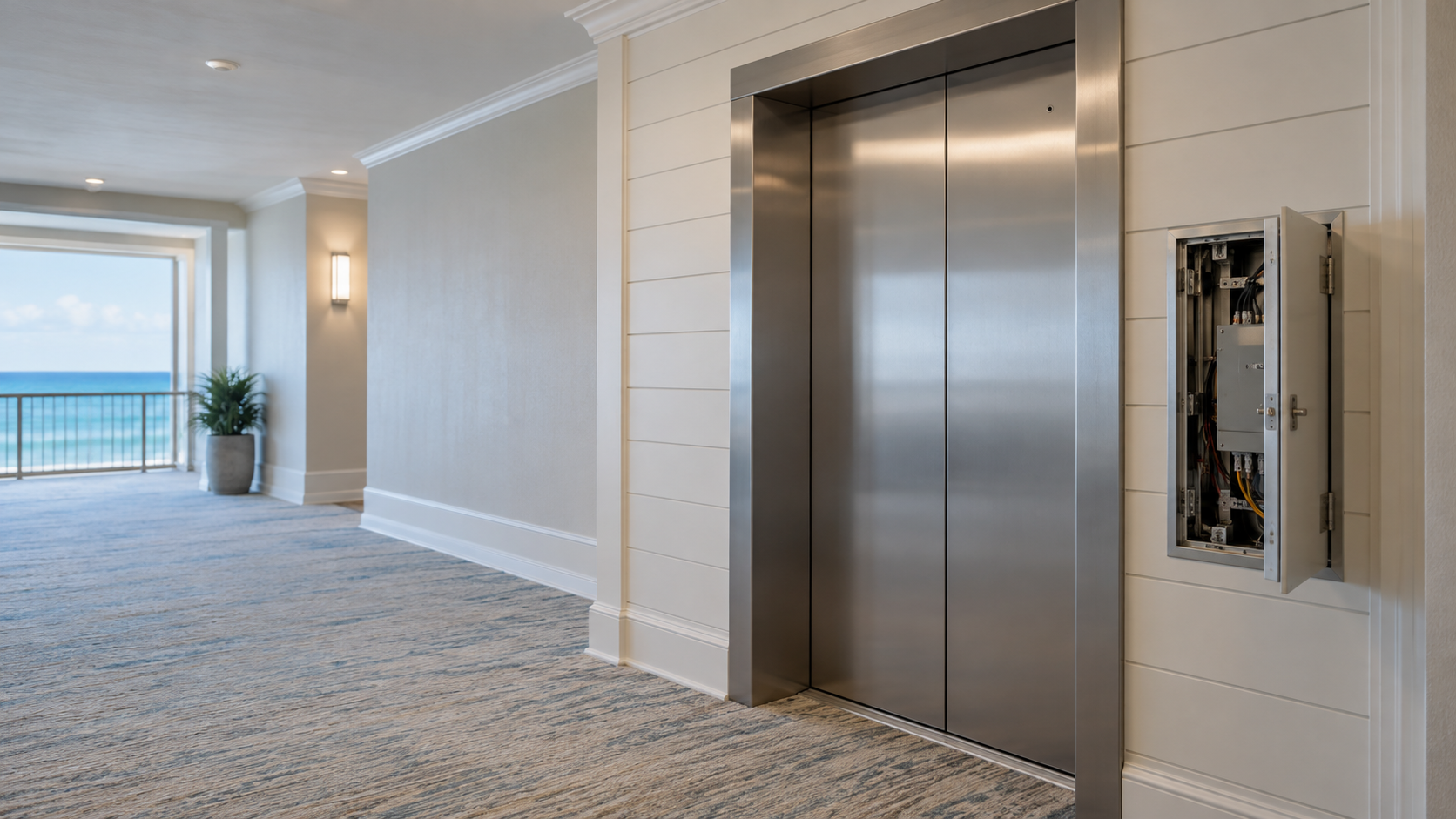
Elevators are the most common source of a surprise assessment in a high rise. They are expensive, they are not optional, and the state can take them out of service. Alabama requires a certificate of operation before any conveyance is used, under Ala. Code 25-13-18(a). Annual inspection by a licensed elevator inspector is required under 25-13-24(a).
A strong answer gives the install year, the last modernization date, and the current certificate for each car. Ask for the last two inspection reports and the service contract. In a Gulf-front building, ask about the hoistway and the controller. Salt air reaches both.
A board that answers with how reliable the elevators feel has not answered. Under 25-13-18(c) the administrator can put a non-compliant car out of service until it is reinspected. A tower with one car down in July has a rental problem.
2. When was the roof last replaced, and what is the roof plan?
A low slope roof on a Gulf-front building carries the whole structure's water and takes the full wind load. It is also where the mechanical equipment sits. So a roof project usually drags condenser units, vents and railings along with it. Roofs are predictable, which is why an unfunded roof is a board problem.
A strong answer names the install year, the warranty term, the last inspection date and the budget line funding replacement. Ask whether the roof carries a FORTIFIED designation. Then ask the insurance agent what that designation does to the master policy premium.
A roof called fine because it is not leaking is being judged by the wrong test. Membranes fail at the edges and the penetrations first. The leak shows up in a top-floor unit after the next storm. Ask for the report, not the impression.
3. Has anyone inspected the balconies, rails and exterior concrete?
Salt air drives chloride into concrete. Chloride corrodes the steel inside, and corroding steel expands and cracks the concrete off. That is spalling, and it shows first on balcony edges, slab soffits and railing posts. Concrete repair on a high rise needs engineering and access equipment, which is why it arrives as an assessment.
A strong answer produces a structural engineer's report with a date on it, plus photographs and a repair schedule. Look for rust stains running from a railing post, hollow sounding concrete, and patches that keep coming back. Ask when the last full exterior survey was done.
A board that has never had an engineer look at the exterior is not automatically negligent. A newer building may not need one yet. It becomes a problem when nobody can say when the last survey happened. In salt air, no survey means no information.
4. When is the building due for waterproofing and exterior painting?
Exterior coatings and sealants are the building's first defense, and they are consumable. Caulk joints, deck coatings and the paint system all run on a cycle. That cycle is shorter on a Gulf-front wall than it is inland. When the coating goes, water reaches the concrete behind it, and a paint budget becomes a concrete budget.
A strong answer states the year of the last full exterior project and the planned year of the next. Ask what the scope covered: sealant replacement, balcony deck coating, and the paint system itself. Most of the cost is access, so ask how scaffolding was priced.
Deferring the coating cycle to hold dues flat costs the most, and it is the most common choice. It reads as good management for years. Then the exterior project and the concrete repair arrive together, and the assessment is the sum of both.
5. Who owns the windows and sliding glass doors, the association or me?
Windows and sliding glass doors fail early on the Gulf. They also sit on the line between common element and unit. The declaration decides which side they fall on, and that decides whether a failed slider is a personal expense or a building-wide assessment. Owners usually find out at the worst moment.
A strong answer is a sentence from the declaration, quoted rather than summarized. Ask whether the building has run a coordinated window and slider replacement, and whether it required a specific impact rating. A building that has standardized its openings is further along than one that has not.
A board that says owners handle their own sliders, with nothing in the declaration behind it, is setting up a dispute. The grey here is real. Many declarations split the glass from the frame. That is a reason to read the document, not to assume.
6. Does the building have to change its exterior lighting, and has it been budgeted?
Exterior lighting is the newest assessment trigger here, and many boards have not priced it. Orange Beach adopted Ordinance 2025-1498 on February 18, 2025, applying wildlife friendly lighting standards in the Beach Overlay District, which runs north and south of Highway 182 from the Florida line to the Gulf Shores city limit. A Gulf-front tower has many fixtures inside that scope.
A strong answer is a fixture count with a quote attached. The ordinance calls for long wavelength, downward directed, full cutoff fixtures at 560 nanometers or greater, with glass at 45 percent or less inside to outside light transmittance.
A board betting the city will not enforce the rule gambles with owners' money. Replacing fixtures on a schedule is a budget line. Replacing them under a citation, on the city's schedule, is an assessment. The ordinance refers violations to the city code's general penalty section, so ask the city.
7. What condition is the pool, the spa and the pool deck in?
The pool is the amenity owners notice and the system boards defer. It is also permitted. An operating permit is required for a public swimming pool or spa in Alabama. The health department inspects permitted facilities at least twice from May 1 to August 31, and at least twice from September 1 to May 1.
A strong answer shows the current operating permit and the last two inspection reports. Then ask about the deck rather than the water: pavers, drainage, the membrane under a raised deck, and the equipment room. Orange Beach realtors who work Gulf-front buildings treat a deck rebuild as a structural project.
A clean pool tells an owner about chemistry, not about capital. The expensive parts are the shell, the plumbing under the deck and the membrane nobody can see. A closed pool in season is also a rental problem, so a deferred pool project carries two costs.
8. Is there a seawall or shoreline structure, and who maintains it?
A seawall or bulkhead is a capital item with a permit attached. In Alabama's coastal area, shoreline stabilization work, including seawalls, bulkheads, jetties and groins, needs an individual permit from the U.S. Army Corps of Engineers, reviewed jointly and concurrently with the Alabama Department of Environmental Management under its coastal program rules. Permitting adds time and engineering cost.
A strong answer identifies what shoreline structure the property has and who is responsible for it. Ask for the last condition inspection and permit file. In Orange Beach and Gulf Shores, where Heather Loper & Associates works, buildings often carry Gulf frontage and waterway frontage.
A board with no file on its shoreline structure has not planned for it. Not every building has one, and that is one less liability. The problem is a board that owns a bulkhead and never looked at it. The failure is sudden. The permit is not.
Eight systems, eight documents. A board that can produce all eight is managing the building.
| System | Document to ask the board for | Warning sign |
|---|---|---|
| Elevators | Certificate of operation and the last two inspection reports | No modernization date on record |
| Roof | Install year, warranty and the funding line | Judged by whether it leaks |
| Concrete and balconies | A dated structural engineer's report | No exterior survey has ever been done |
| Coatings and sealants | Year of the last full exterior project | Cycle deferred to hold dues flat |
| Windows and sliders | The declaration language on openings | Verbal answer, nothing in writing |
| Exterior lighting | Fixture count with a compliance quote | Board assumes nobody will enforce it |
| Pool and deck | Operating permit and inspection reports | Clean water, no deck inspection |
| Shoreline structure | Condition inspection and permit file | No file at all |
Frequently Asked Questions
Can an Alabama condo board levy a special assessment without an owner vote?
It depends on the declaration and bylaws, which matter more than any general rule. Ala. Code 35-8A-315 requires assessments at least annually, based on a budget adopted at least annually. It also lets the association charge interest on past-due amounts at a rate it sets, not exceeding 18 percent per year.
What does the resale certificate have to tell a buyer about assessments?
Under Ala. Code 35-8A-409 the certificate states the periodic assessment, any unpaid common expense or special assessments past due or then due, the most recent balance sheet and income and expense statement, the current operating budget, any unsatisfied judgments and pending suits, and the insurance coverage.
Who pays a special assessment if the unit sells while the work is underway?
The contract decides it between buyer and seller, so the question belongs in the offer rather than at closing. The resale certificate shows what is past due or then due on that unit. Ala. Code 35-8A-315 also provides that no unit owner is exempt from liability for an assessment, including by nonuse or waiver.
Does a reserve study mean the building will not need an assessment?
No. A reserve study estimates remaining service life and replacement cost on a given date, using the information available then. Storm damage, a failed inspection or a high bid can all outrun it. A funded study lowers the odds of an assessment. It does not remove them.
Does hurricane damage come out of insurance or out of a special assessment?
Usually both. Insurance responds above the master policy deductible, and on a coastal building that deductible can be a percentage rather than a flat figure. How it is allocated among owners is set by the declaration. Ask the manager what the deductible is and which document says who pays it.
Read the building before you read the budget
Heather Loper & Associates works with Gulf-front owners and buyers in Orange Beach and Gulf Shores, and reviews building documents alongside the numbers. Owners comparing the best real estate agents in Orange Beach can reach the team at heatherloper.com or (251) 504-1171.
This article is general information about condominium building systems and assessments in Alabama. It is not legal, engineering or insurance advice. Read the declaration and bylaws for the specific building, and have a licensed engineer or attorney review anything that carries a cost.
or another way