
Categories
Dune walkover permit, General, Gulf Shores sea turtle lighting ordinance, Leave Only Footprints ordinancePublished September 18, 2026
7 Beachfront Rules Gulf Shores and Orange Beach Owners Follow

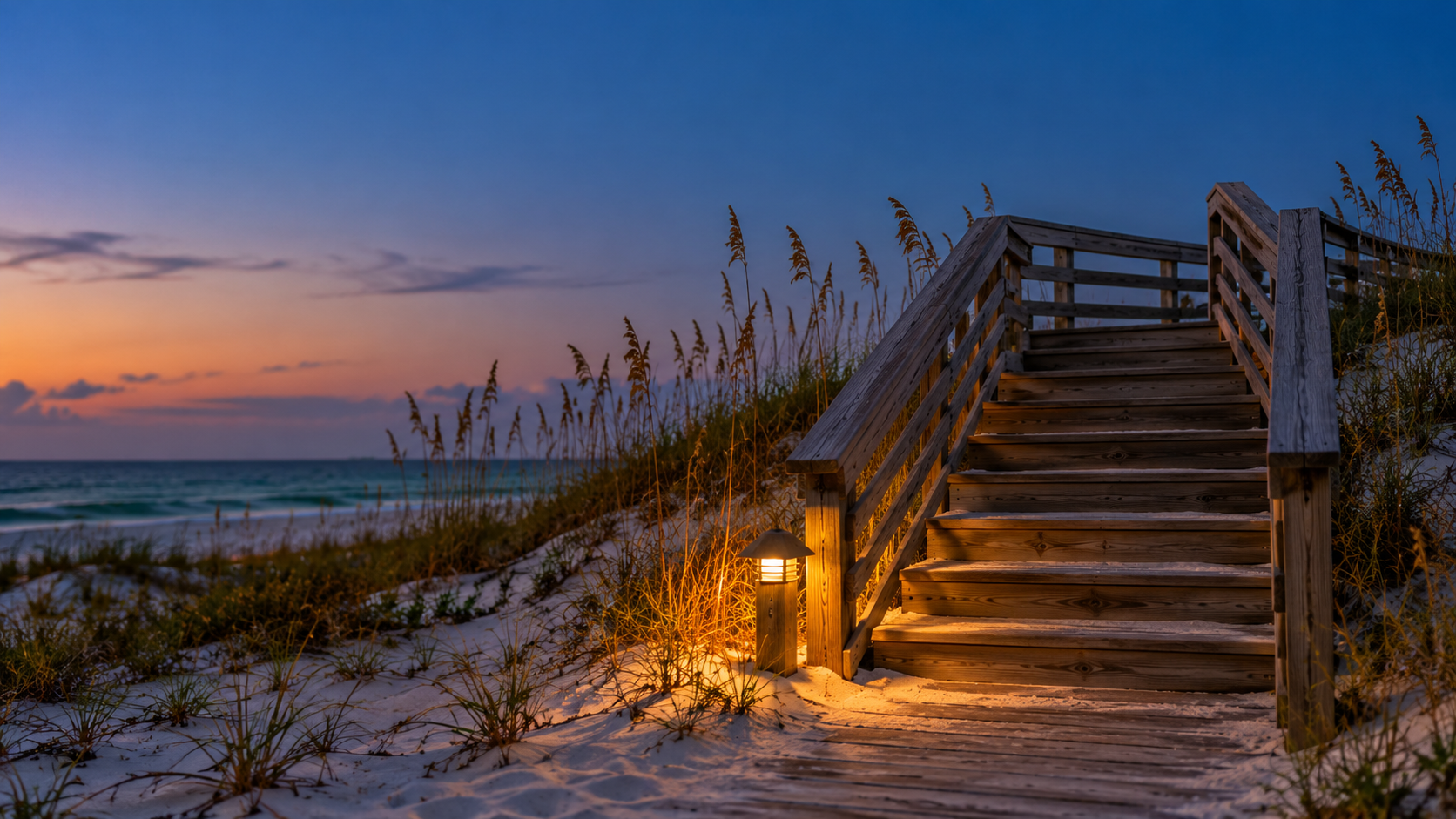
7 Beachfront Rules Gulf Shores and Orange Beach Owners Have to Follow
The beachfront rules in Gulf Shores and Orange Beach are local, written down, and enforced by the cities.
They bind every Gulf-front owner and every rental manager, and a guest who breaks one creates a problem for the owner. These are the seven that matter most.
The seven rules, in short:
1. What are the lighting rules during sea turtle nesting season?
Lighting is the most technical beachfront rule and the one most owners get wrong. Orange Beach adopted Ordinance No. 2025-1498 on February 18, 2025, setting wildlife friendly lighting standards in its Beach Overlay District. The ordinance names the nesting season as May 1 through October 31 of each year.
A strong answer is a fixture list. The ordinance calls for long wavelength, downward directed, full cutoff, fully shielded fixtures at 560 nanometers or greater, appearing amber, orange or red. Parking lot fixtures in line of sight of the beach are capped at 55 watts.
Swapping a bulb and calling it done is the usual shortcut. The standard covers the fixture, the direction and the shielding, not just the color. Each violation, and each day it continues, counts as a separate offense.
2. Do I have to take everything off the beach at night?
Yes, and both cities say so in an ordinance. Gulf Shores requires all non-permitted personal items, from chairs and umbrellas to tents and coolers, off the beach each night, and not placed there before sunrise. The rules sit in Ordinance 1792 and Ordinance 1773.
A strong answer tells guests where to put the gear and when. Gulf Shores may treat items left between one hour after sunset and sunrise as abandoned property. Orange Beach deems the same items abandoned, and disposes of them without return.
Leaving a set of chairs out for the next day is the habit that costs guests their gear. Rental owners who leave it out of the house rules end up refunding it. The rule also protects nesting turtles, which is why neither city treats it as minor.
3. How big can a tent or canopy be on the beach?
Orange Beach puts a size limit in writing. A tent, canopy or structure is anything with more than a single point of contact with the ground. Structures larger than 12 feet by 12 feet are not allowed. Anything over 7 feet wide or 4 feet high goes north of the Leave Only Footprints marker posts.
A strong answer gives guests the number before they pack. A single pole umbrella is not a structure under that definition. A four-leg canopy is. Put the size limit and the marker post rule in the arrival instructions.
Assuming a canopy is fine because other people have one is the common error. The marker posts move with the season and the beach profile, so last year's spot may not be legal this year. The honest grey: a small umbrella is almost never an issue.
4. Can I dig a hole in the sand, and do I have to fill it in?
Holes in the sand are a safety and wildlife issue, and Orange Beach addresses both. Metal detecting is allowed, and anyone who digs must fill in any holes. Excessive digging deeper than twelve inches is prohibited. An open hole at night traps a hatchling.
A strong answer is simple enough for a fridge magnet. Leave the metal shovels at home, dig shallow with a small plastic one, fill the hole before you leave, and knock the sandcastles down at the end of the day. Say it in the house rules, because guests rarely think a rule covers a hole.
A rental listing that promotes digging and castle building without the fill-in rule is setting guests up. The rule is not about ruining anyone's day. It is about what the beach looks like at two in the morning in July, when a hatchling is crossing it.
5. Am I allowed on the dunes, or do I have to use the walkover?
Both cities say to keep off the dunes and use the walkovers provided. The dune system holds the beach in place during a storm, and the vegetation holds the dune together. Alabama's coastal rules protect that vegetation on land seaward of the construction control line. Landward of it the city's rules govern.
A strong answer points to the walkover and explains why it exists. Alabama Admin Code 335-8-2-.08 prohibits removing primary dune or beach sands and vegetation, or altering the primary dune system, on land between mean high tide and the construction control line. Where that line crosses a parcel it reaches an owner's own dune, not only public access points.
Cutting a path through the dune to shorten the walk is the behavior with the longest consequence. It is also the one owners rationalize most easily. A breached dune funnels storm water straight at the house behind it.
6. Do I need a permit to build or rebuild a dune walkover?
Usually yes. Alabama's coastal rules require a permit before anyone builds a new structure, or substantially improves an existing one, between mean high tide and the construction control line. Inside the Gulf Shores and Orange Beach city limits the city permits that work. On unincorporated Fort Morgan the county's Coastal Area Program handles it.
A strong answer starts with a survey and with the right office. The county program requires a recent survey prepared and stamped by a Professional Land Surveyor registered in Alabama for a dune walkover, and that quality of survey is the right starting document either way. Gulf Shores realtors handling Gulf-front property should be able to say whether the control line crosses a parcel.
Rebuilding a storm damaged walkover exactly as it stood, without checking, is the assumption that creates a violation. Repair and substantial improvement are not the same thing. Ask before the contractor mobilizes.
7. What do I have to tell guests about the beach warning flags?
The flag system is a public safety rule, not advice. Gulf Shores tells beachgoers to observe and obey the Beach Warning Flag System, and states that double red flags mean the waters are closed. A closure applies regardless of how calm the water looks from a balcony.
A strong answer puts the flag colors in the rental welcome packet and tells guests where the nearest flag station is. In Orange Beach and Gulf Shores, where Heather Loper & Associates works, owners often add a photo of the nearest flag pole.
A listing that promises swimming without mentioning closures oversells the beach. Double red days happen, often in the weeks the surf looks most inviting. Guests who were never told will swim anyway.
Both cities publish the rules. The wording differs, so read the one for your city.
| Rule | Gulf Shores | Orange Beach |
|---|---|---|
| Personal items | Removed each night, not placed before sunrise | Removed one hour after sunset |
| Items left behind | May be treated as abandoned property and disposed of | Deemed abandoned and disposed of without return |
| Tents and canopies | Non-permitted tents come off the beach nightly | Nothing larger than 12 feet by 12 feet |
| Dunes | Keep off the dunes, use the walkovers | Keep off the dunes, use the walkovers |
Frequently Asked Questions
Who enforces the beach rules, and what happens if a guest breaks one?
The cities do, through their codes of ordinances. In Orange Beach, lighting violations are penalized under section 1-7 of the city code, and each day a violation continues counts as a separate offense. Gulf Shores enforces through its Leave Only Footprints and beach litter ordinances.
Am I responsible for my rental guests following these rules?
Practically, yes, and the license puts your name on it. Gulf Shores requires a rental property business license, a local emergency contact designated and maintained by the licensee, and a rental safety inspection every 3 years. Written house rules are the cheapest protection available.
Can I trim or remove the sea oats on my own dune?
Not if the dune sits seaward of the construction control line. Alabama Admin Code 335-8-2-.08 prohibits removing primary dune or beach sands and vegetation, or otherwise altering the primary dune system, on land between mean high tide and that line. Owning the dune does not change that. Landward of the line, the city's rules govern instead. Either way, if a view is the goal, ask the permitting office before anyone cuts anything.
When is sea turtle nesting season on the Alabama Gulf Coast?
Orange Beach names it as May 1 through October 31 of each year in its wildlife friendly lighting ordinance. That window covers most of the rental season, so plan exterior lighting work for the months on either side of it.
Do the lighting rules reach interior lights too?
They can. The Orange Beach ordinance addresses glass, calling for an inside to outside light transmittance value of 45 percent or less, so interior light spilling onto the beach is in scope. Closing the blinds on the Gulf side is the simplest fix.
Buying or renting out a Gulf-front property
Heather Loper & Associates works with beachfront owners in Gulf Shores and Orange Beach and knows which rules follow the property rather than the owner. Owners comparing the best real estate agents in Gulf Shores can reach the team at heatherloper.com or (251) 504-1171.
This article is general information about beachfront ordinances in Gulf Shores and Orange Beach, Alabama. It is not legal advice. Ordinances are amended, so confirm the current rule with the city before changing lighting, building a walkover or publishing house rules.
or another way