
Categories
breakaway walls, Buyer, Elevation certificate, Baldwin County, Flood vents under an elevated house, Official Alabama Wood Infestation Report, salt air corrosionPublished September 17, 2026
12 Things a Coastal Home Inspection Should Cover in Baldwin County

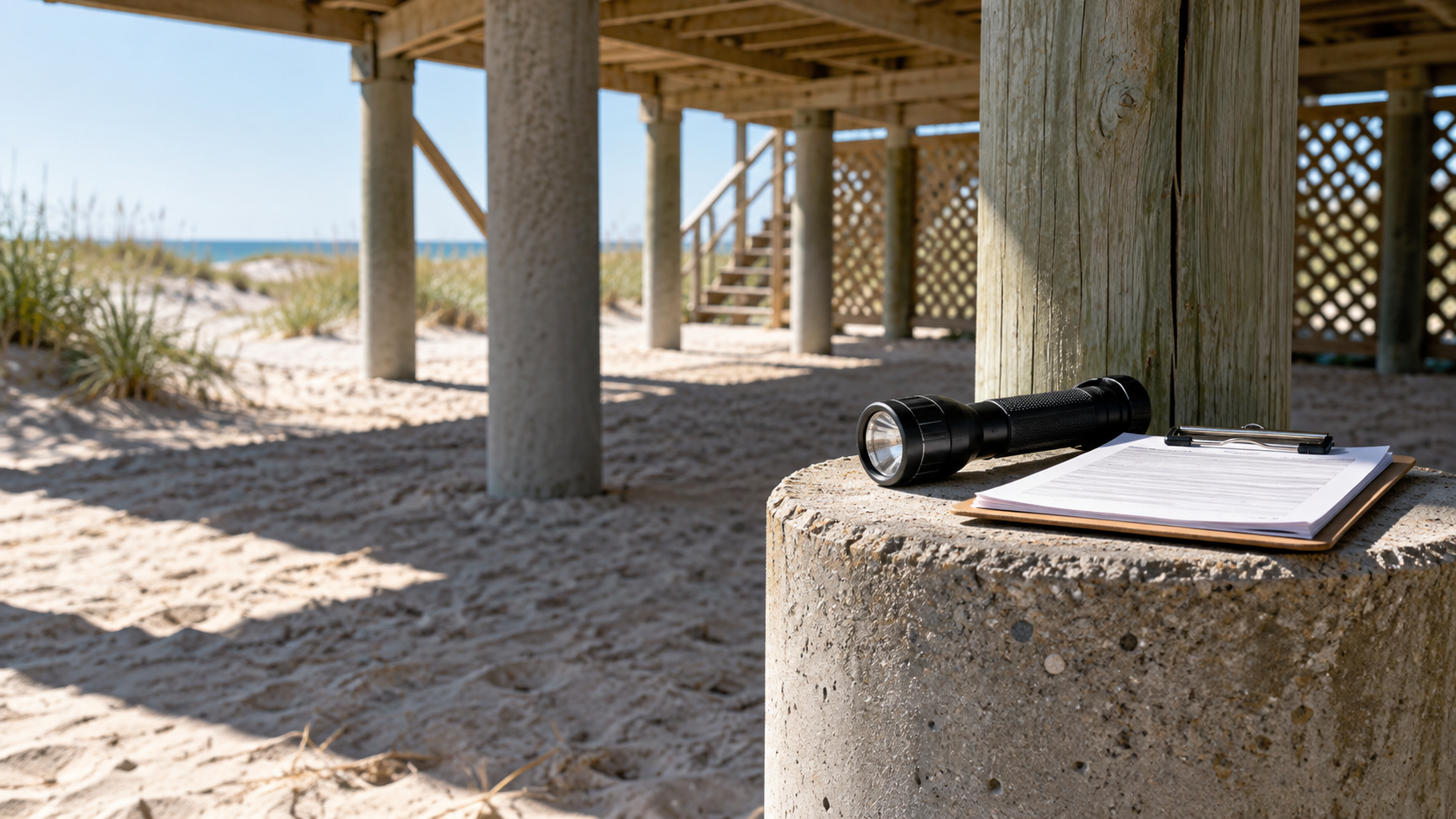
12 Things a Coastal Home Inspection Should Cover in Baldwin County
A coastal home inspection in Baldwin County is not a longer version of an inland one. It is a different list.
The things that cost the most here sit under the house, in the city permit file, and in two reports a general inspector does not write.
Here are twelve things the inspection should cover, who is allowed to check each one, and the document a buyer should end up holding.
The twelve checks, in short:
- Who is licensed to inspect
- Elevation and the freeboard rule
- Pilings and the elevated foundation
- Flood vents under the house
- Breakaway walls below the floor
- Whether opening protection is rated
- Roof attachment and the premium
- Salt air corrosion on metal
- Humidity in an empty house
- The wood infestation report
- Septic certification by the county
- Open permits and unpermitted work
1. Who is actually licensed to inspect a house in Alabama?
Alabama licenses home inspectors through the Building Commission, administered by the Department of Finance, Real Property Management, Division of Construction Management. Under Ala. Code 34-14B-3 an applicant files an application under oath on the Commission's form. The applicant must also pass the National Home Inspection Examination and a standards and ethics examination, complete approved education, participate in inspections and draft 25 inspection reports.
Ask for the license and the errors and omissions certificate. A licensed inspector carries general liability coverage of $20,000 for property damage, $50,000 per person and $100,000 for more, plus $250,000 of errors and omissions coverage. A slab house in Foley and a piling house in Gulf Shores are different inspections.
An inspector who will not produce the license is the easy decline. The harder one is the licensed generalist who has never worked under an elevated house, so the report reads clean.
2. Is the house high enough, and where do I find the elevation certificate?
Coastal cities here set a freeboard above the base flood elevation. Under its Floodplain Development Ordinance 2024-1472, Orange Beach requires the lowest floor to sit no lower than two feet above base flood elevation in Zone AE. In VE, Coastal A or Coastal AE it requires the bottom of the lowest horizontal structural member to sit no lower than three feet above it. The city keeps elevation certificates on file.
Ask the seller for the elevation certificate. If nobody has it, ask the city, which keeps elevation certificate information for development in the special flood hazard area at its community development office. That certificate drives the flood premium.
A listing that says the house sits above flood level, with no certificate, is an opinion. So is a flood quote given without one. A house that only just clears an older standard can cost far more to insure.
3. Are the pilings and the elevated foundation sound?
On an elevated coastal house the pilings carry everything. Concrete pilings crack and spall as salt reaches the reinforcing steel inside, because the rust expands and pushes the concrete off. Wood pilings rot at the sand line and at every bolted connection. Sand that has washed away from a piling base is its own finding.
A good report photographs every piling, names the ones with exposed steel, and says whether the hardware between piling and beam is corroded. Ask the inspector to sound the concrete rather than look at it. In Gulf Shores that work happens in the sand under the house, not from the driveway.
Fresh paint on a piling is worth asking about rather than admiring. Sometimes it is maintenance and sometimes it is a cover. An inspector who reports the foundation as serviceable, with no piling by piling note, has not inspected it.
4. Does the area under the house have proper flood openings?
An enclosure below the lowest floor has to let water in and out, or the water pushes the walls instead. Orange Beach requires a minimum of two openings for each enclosed area, with a total net area of not less than one square inch for every square foot of enclosed area. Screens, louvers and covers all reduce net area.
Measure the enclosure, count the vents, and do the arithmetic at the kitchen table. Ask whether these are engineered flood vents with a rating or plain louvers. Ask too whether anything has been added under the house since the certificate of occupancy.
Finished rooms under an elevated beach house are the classic problem. A storage area quietly converted into a bunk room usually breaks the opening requirement, the insurance rating and the floodplain permit at the same time.
5. Are the walls under the house actually breakaway walls?
In a velocity zone the walls below the lowest floor are designed to fail on purpose, so a surge takes the wall instead of the house. Orange Beach requires a breakaway wall to have a design safe loading resistance of not less than 10 and no more than 20 pounds per square foot. A wall built too strong defeats the design.
Ask the inspector to note the wall construction below the lowest floor, and whether it reads as a lattice or infill panel or as a framed and braced wall. Where it looks reinforced, ask the city building department what the permit file says.
Owners sometimes upgrade those walls to make a storage area more secure, with no idea what the change does. It is an honest mistake and an expensive one, because a surge then loads the structure instead of the panel.
6. Is there opening protection on the windows and doors, and is it rated?
On the Alabama coast the windborne debris region is where the residential code requires opening protection, and whether a parcel falls inside it depends on the design wind speed at that site. Orange Beach's own wind load compliance design certificate states that the building is located in a windborne debris region and that opening protection is required, citing IRC Section R301.2.1.2. Ask the permitting office for the parcel which applies.
Rated means tested glazing, or tested shutters with product documentation, not plywood cut to fit. Ask for the product approval numbers on the windows, doors and shutters, and check that the number of shutters matches the number of openings.
A seller who says the windows are hurricane windows without documentation is reading the brochure. Missing panels for two openings is common too, and it is the kind of gap a buyer discovers on the morning of an evacuation order.
7. How is the roof attached, and will an insurer care?
On the Alabama coast the roof is the insurance conversation. A sealed roof deck, ring-shank nails installed in an enhanced pattern, a wider drip edge with a fully adhered starter strip, a rated roof cover and wind and rain resistant attic vents are what the FORTIFIED Roof standard calls for. Roof-to-wall connections, the straps and clips, sit at the next level up.
Ask for the roof covering age, the deck fastening visible from the attic, and photographs of the strapping at the top plate. Then ask for a FORTIFIED designation certificate. In Gulf Shores and Orange Beach, where Heather Loper & Associates works, that one page changes the quote.
A new roof is not the same as a documented roof. The shingles can be two years old and still earn nothing, because the credit follows the certificate. Ask for the roofing permit as well.
8. How much salt air corrosion is hiding in the metal parts?
Salt air shortens the life of every metal component on a beach house. The outdoor air conditioning unit usually goes first, because the coil fins corrode and capacity drops long before the unit stops running. Hinges, fasteners, railing anchors, garage door tracks, light fixtures and the main electrical panel are all on the same clock.
Ask for the age and the nameplate of the outdoor unit, and for a photograph of the coil. Ask the inspector to open the main panel and photograph the bus and the breaker lugs. A coastal inspector should also check railing anchors where they enter concrete.
A report calling the air conditioner functional at the time of inspection has answered nothing about remaining life. Coastal condensers do not fail politely in spring. They fail in July, when every contractor in Gulf Shores is already booked.
9. What about moisture and mold in a house that sits empty between stays?
A closed vacation house on the Gulf Coast runs humid unless something is controlling it. The air conditioner only dehumidifies while it runs, and a thermostat set high for an empty week may not run enough. Moisture then shows up in closets, behind furniture, at window frames and in wall assemblies that cannot dry outward.
Ask for moisture meter readings at exterior walls, under windows, and at any stucco or synthetic stucco surface. Ask whether the house has a humidistat or a standalone dehumidifier. Ask what the thermostat was set to while the house sat empty.
A faint musty smell that a listing explains as the house being closed up deserves one more look, not a shrug. Sometimes that is all it is. Sometimes it is a wall that has been wet for two seasons behind intact paint.
10. Has anybody inspected for termites, and what does that report actually promise?
Alabama has a specific document for this. Only a person certified in the control of wood destroying organisms may issue the Official Alabama Wood Infestation Report. It covers visible and accessible areas, and inspection of inaccessible areas is not required. Where it certifies apparent freedom from infestation, the licensee treats free of charge if an infestation is found within ninety days, subject to conditions the rule sets separately by organism.
Get the report in the buyer's own name and read the diagram, not the summary line. Ask what was inaccessible and why. Then ask whether the house carries a current termite bond and whether it transfers at closing.
A clean report on an elevated wood frame over damp sand is not a guarantee. The 90 day promise covers treatment, not damage, and damage is the expensive half. Read which organism the guarantee covers, and read the bond.
11. Is the septic system working, and who is allowed to certify it?
Houses outside the city sewer systems in Baldwin County sit on onsite sewage systems, and the county health department is the authority. Its existing system certification request carries a $75.00 fee as of October 2026, and the inspection requires the septic tank inlet, outlet and baffle wall to be uncovered and opened. The disposal field and the end of each line have to be marked.
Start the request early, because the county inspects in dry conditions and rain delays it. Ask the seller for proof the tank was pumped and for the original permit. Ask whether the system was sized for the bedroom count advertised.
A seller offering a plumber's letter instead of a county certification has offered the wrong document. The health department is the office whose opinion follows the property, and a system undersized for the bedroom count becomes the buyer's problem at the first full house.
12. Are there open permits or unpermitted work in the city's file?
The city building department keeps the permit history, and it is public. A permit that was opened and never finaled is a live problem for a buyer, because the next owner inherits it. Enclosures, decks, hot tubs, window replacements and reroofs are the usual entries, and the usual omissions.
Pull the address history from the city before the inspection deadline. In Orange Beach that file can include a wind load compliance certificate naming the code edition, the design wind speed and the exposure class. Gulf Shores realtors pull these as routine, because the answer changes what the inspector looks for.
A seller who says the work was done by a licensed contractor has answered a different question than whether it was permitted. Unpermitted work under an elevated house costs the most, because undoing it can mean undoing the enclosure.
Five checks on a coastal house, the office that performs each one, and what a buyer should end up holding.
| What gets checked | Who performs it | The document to keep |
|---|---|---|
| Elevation and freeboard | City floodplain administrator | FEMA elevation certificate |
| Termites and wood destroying organisms | Certified pest control licensee | Official Alabama Wood Infestation Report |
| Onsite sewage system | Baldwin County Health Department | Existing system certification |
| Opening protection and wind design | City building department | Wind load compliance certificate |
| Overall condition | Licensed Alabama home inspector | Inspection report with photographs |
Frequently Asked Questions
What is the biggest red flag in a home inspection?
On this coast it is water where water should not be, and structure that has been changed without a permit. A ceiling stain can be a one day repair. An enclosure built under an elevated house, or a wall below the lowest floor built too strong to break away, reaches the structure, the insurance and the city file at the same time.
What are the most common home inspection fails?
Corroded outdoor air conditioning units, roof coverings near the end of their life, missing or reduced flood openings, rotted deck framing and railing anchors, and plumbing leaks under a house nobody crawls beneath. None of it is surprising. All of it costs more on a raised beach house, because access costs money too.
Should I be there for the inspection?
Yes, for the last hour of it. The report lists conditions, and the conversation is where the inspector says which ones to fix first. On an elevated house, ask to be walked underneath it. Fifteen minutes in the sand teaches a buyer more than the summary page does.
Can I go back to the seller for repairs after closing?
Generally no, which is why the inspection sits inside the contract deadline. Alabama follows caveat emptor on the sale of an existing home. The real estate commission's own consumer guidance says sellers and their agents are not required to disclose defects except those that might pose an immediate health or safety risk, and must not misrepresent conditions they are asked about.
Does a condo need the same inspection?
Not the same one. A unit inspection covers the interior, the heating and cooling equipment, the plumbing inside the unit and the balcony surface. The building's roof, pilings, windows and common systems belong to the association, so the condo version of this question lives in the reserve study, the engineering reports and the master insurance policy.
Have Heather Loper & Associates line up the inspections
Heather Loper & Associates works Gulf Shores and Orange Beach, where a coastal inspection means the city permit file, the elevation certificate, the termite report and the county septic certification, not one visit. Buyers comparing the best real estate agents in Gulf Shores can reach the team at (251) 504-1171 or through heatherloper.com.
This article is general information about coastal inspections and Alabama disclosure law. It is not legal advice. Check your own situation with an Alabama attorney and a licensed inspector.
or another way