
Categories
Home OwnerPublished August 22, 2026
10 Steps Condo Owners Should Take Before a Hurricane in Orange Beach

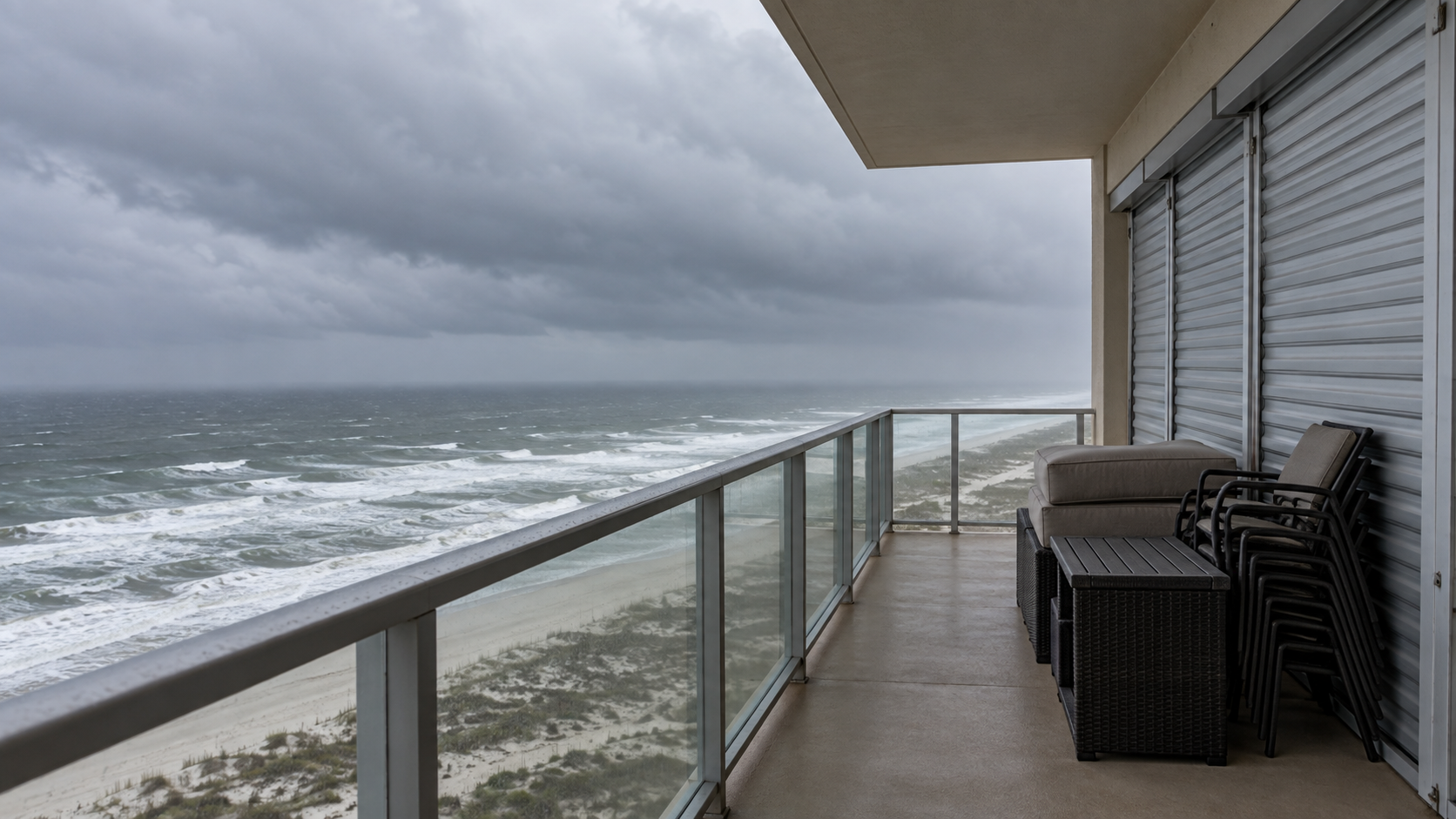
10 Steps Condo Owners Should Take Before a Hurricane in Orange Beach
A hurricane checklist for condo owners in Orange Beach is not the same list a house on a lot needs. The association controls the balcony, the shutters and the master policy, and an owner controls the rest.
These are the ten steps to take before a storm, in the order they actually happen, from a quiet week in May to the claim afterward.
The ten steps, in short:
-
Knowing your evacuation zone
-
Coverage in force and the wind deductible
-
Flood coverage and the waiting period
-
Where the master policy stops
-
Documenting the unit in advance
-
Shutter and balcony rules
-
Who is at the unit when it counts
-
Getting the re-entry decal early
-
What to do once a warning lands
-
Filing and documenting the claim
1. Which evacuation zone is my condo in?
Baldwin County splits the coast into five evacuation zones. Zone 1 covers all areas of Pleasure Island, where Orange Beach and Gulf Shores sit. It also covers manufactured homes elsewhere in the county. Zone 1 is called for a Category 1 storm, so an Orange Beach condo is in the first group asked to leave, every time.
A prepared owner knows the zone, the route inland and the driving time in traffic before the season starts. Print the county evacuation map and keep it with the policies. If the unit is rented, the guest handbook should carry the same map and the same phone numbers.
Waiting for a storm to be named before learning any of this is the common version of unprepared. Evacuation orders come with hours of notice, not days, and the bridges off Pleasure Island carry everyone at once. A plan made in May takes twenty minutes. Made in August, it does not exist.
2. Is my insurance actually in force, and what is my wind deductible?
Wind losses often carry their own deductible, separate from the one on the rest of the policy. The Alabama Department of Insurance tells owners to check whether a special deductible applies to windstorm, hail or hurricane losses, and says it is shown either as a dollar amount or as a percentage of the insured value. The Alabama Insurance Underwriting Association calculates its percentage deductible on the total insurable value of the structure rather than the policy limit.
Pull the declarations page in May and read the deductible line out loud. Ask a licensed Alabama insurance agent whether the policy covers the interior, the cabinetry and anything you installed, since that is the part the association policy may not reach.
Assuming the dues cover everything is the expensive mistake here. So is leaving a coverage change until a storm has a name, because carriers set their own rules on when a change can be placed. Ask the agent what those rules are in a quiet week.
3. Do I have flood insurance, and when does it start?
Flood is not part of a standard property policy, and a new federal flood policy normally takes effect 30 days after purchase. The exceptions are narrow. They cover a mortgage transaction, a change made at renewal, a property newly mapped into a high risk zone within the last twelve months, and certain post wildfire cases. Buying in August does not help in September.
Check the flood zone on the current map, not on the paperwork from the year you bought. FEMA marks the coastal high hazard area as zone V, V1 to V30 or VE. Those are special flood hazard areas with added hazard from wind and wave action. Ask the association what the building's own flood coverage includes.
A unit on a high floor is not a reason to skip the question. Flood coverage also reaches contents, and a building's lower levels, storage and parking take water first. The answer that should worry you is nobody at the association knowing whether the building carries flood coverage at all.
4. What does the association cover, and what is mine?
Alabama law requires a condominium association to carry property insurance on the common elements and liability insurance, to the extent that coverage is reasonably available. That insurance need not include improvements and betterments a unit owner installed. It also does not stop an owner from buying insurance for their own benefit. The line between the two is where most arguments after a storm happen.
Ask the management company for the master policy declarations page and the association's written position on where its coverage stops: drywall, cabinets, flooring, appliances, the balcony surface. Keep that page with your own policy. Heather Loper & Associates works with condo owners in Orange Beach and Gulf Shores, where that one page answers most storm questions.
A board that cannot say where the master policy stops has a problem you will end up paying for. So does an owner who has never asked. Find out in May, when the answer costs an email, rather than in October, when it costs a claim.
5. Have I documented what is in the unit before the storm?
A claim is only as good as the record behind it. The Alabama Department of Insurance tells owners to create a current inventory of personal property. Photograph and record each room and the exterior, note model and serial numbers, and attach receipts. It also says to keep copies of the policies and the inventory away from the property.
Walk the unit with a phone, open every cabinet and closet, and say out loud what things are. Shoot the balcony, the entry door and the corridor. Store it somewhere that is not in the unit and not only on the phone. Redo it whenever furniture is replaced, which in a rental unit is often.
A folder of photos with no dates and no receipts is weaker than it looks. So is an inventory that lives on a laptop inside the condo. If the record and the property can be destroyed by the same event, the record is not doing its job.
6. Do I know the association's shutter and balcony rules?
Balconies are usually a common element or a limited common element. That means the association, not the owner, sets the rules for them. Many declarations require balconies to be cleared before a storm and control what can be fixed to the opening. Those rules decide what an owner is allowed to do, and who is expected to do it.
Read the storm section of the rules once, in writing, and keep it with your policies. Ask what the association handles automatically, what it expects owners to handle, and by when. Ask who clears the balcony if the unit is occupied by guests or if the owner lives out of state.
Assuming a maintenance crew will get to your unit is how balcony furniture ends up in a pool. Ask for the written storm procedure, and if there is not one, ask the board for it in April. A rule nobody wrote down is a rule nobody follows under pressure.
7. Who is physically at the unit when a storm is named?
An out of state owner needs a named person on the island who can enter the unit, secure it and photograph it. That person is usually the rental manager, sometimes a neighbor, and occasionally nobody. The last case is the one worth fixing in May. Gulf Shores requires rental license holders to designate a local emergency contact for exactly this reason.
Write the name, the phone number and the key or code access onto one page, and give a copy to the association office. Ask the rental manager for a written storm plan, including who clears the balcony, who handles guest rebooking, and when the unit gets photographed before and after.
A manager who answers this with a line about monitoring the weather does not have a plan. Neither does an owner whose only key holder lives four states away. The question is not who cares about the unit. It is who can physically stand inside it within an hour.
8. Do I have my re-entry decal before the season starts?
Orange Beach issues hurricane re-entry decals through its Finance Department. By city ordinance, the city stops handing them out once a tropical storm or hurricane warning is issued. That makes the decal a spring errand rather than a storm week errand. Without one, getting back onto the island after a storm becomes much harder.
Call the city, confirm what proof of ownership they want and what the current decal cycle is, then collect it before June. If a rental manager looks after the unit, ask who is holding the decal and where it lives. Keep a photograph of it with your policies.
Assuming a deed or a utility bill will be enough at a checkpoint is a bet placed at the worst possible moment. Worth checking too: whether the decal you have is the current one. An expired decal and no decal look the same to the person working the road.
9. What do I do in the unit once a warning is issued?
Once a hurricane warning is posted, the work is short and physical: clear the balcony, close the shutters, unplug what can be unplugged, and turn the refrigerator down. Take the documents that matter with you. The Alabama Department of Insurance advises keeping copies of policies and the property inventory somewhere other than the property itself.
Photograph the unit in its secured state, including the balcony and the closed shutters, with the date visible. That set of photos is the before picture a claim needs. Ask the association whether elevators and water get shut off building wide, because that changes what you can do and when.
Leaving balcony furniture stacked but not moved indoors is the version that fails. So is leaving on the day the order comes, when the bridges off Pleasure Island are already full. Go early, and treat the last hour before you lock up as photographs rather than packing.
10. How do I file and document a claim afterward?
A claim moves faster when the before record already exists and the after record is taken immediately. Photograph everything before anything is moved or thrown away, keep every receipt for repairs and temporary housing, and file with the carrier rather than waiting for the association. Wind and flood are separate claims with separate adjusters.
Open the claim, then track it in writing, with dates and names. Ask the association for its own claim timeline, because building repairs and unit repairs run on different clocks. The file matters later as well, which is why Orange Beach realtors ask for a building's repair history when a unit goes on the market.
Throwing out ruined furniture before it is photographed removes the proof. So does a verbal agreement with an adjuster. Get the scope in writing, keep damaged items until you are told otherwise, and do not sign a repair contract that depends on a settlement you have not seen.
The Hurricane Calendar for an Orange Beach Condo
The sequence an Orange Beach condo owner runs every season, from May to the claim.
Frequently Asked Questions
When does hurricane season start and end?
The North Atlantic hurricane season officially runs from June 1 to November 30, and August through October are the peak months. That makes May the month for the paperwork steps: the decal, the inventory, the policy review and the key holder. By August the useful window for anything that takes an appointment has usually closed.
Can I get a Strengthen Alabama Homes grant for my condo?
No. The program grants up to $10,000 toward a fortified roof and may not cover the whole cost. It is limited to a primary residence and excludes condominiums, townhomes, mobile homes and rental properties. The home also cannot be listed for sale during the process. Grants opened in Jefferson, Tuscaloosa and Escambia counties in November 2025, so check the current award schedule first.
Does the association's deductible come out of my pocket?
Often, indirectly. Under Alabama's condominium act, costs above the insurance proceeds, including the deductible, are a common expense of the association. That reaches owners through dues or a special assessment rather than through a bill with your name on it. Ask the board what the master policy deductible is before the season, not after.
Do my guests get a refund if a storm cancels their stay?
That depends on the management agreement and the booking platform's own policy, and the two do not always match. Read both before the season and make sure the guest handbook says the same thing. Owners who learn the answer during an evacuation usually end up paying for the gap themselves.
Does a fortified roof lower insurance in Alabama?
It can. Alabama law requires an insurer to offer a fortified bronze roof endorsement on an eligible home when covered damage means the roof has to be replaced. The Alabama Insurance Underwriting Association also offers premium discounts for fortified construction and wind mitigation. On a condo the roof belongs to the association, so ask the board what the building is rated.
Sort the storm file in May, not in August
Heather Loper & Associates works with condo owners across Orange Beach and Gulf Shores, Alabama, where the master policy and the association storm rules decide what an owner actually controls. Owners comparing top realtors in Orange Beach can start with the building's repair history and what it means for value.
or another way