
Categories
BuyerPublished September 1, 2026
10 Questions to Ask Before Buying a Home With a Boat Slip

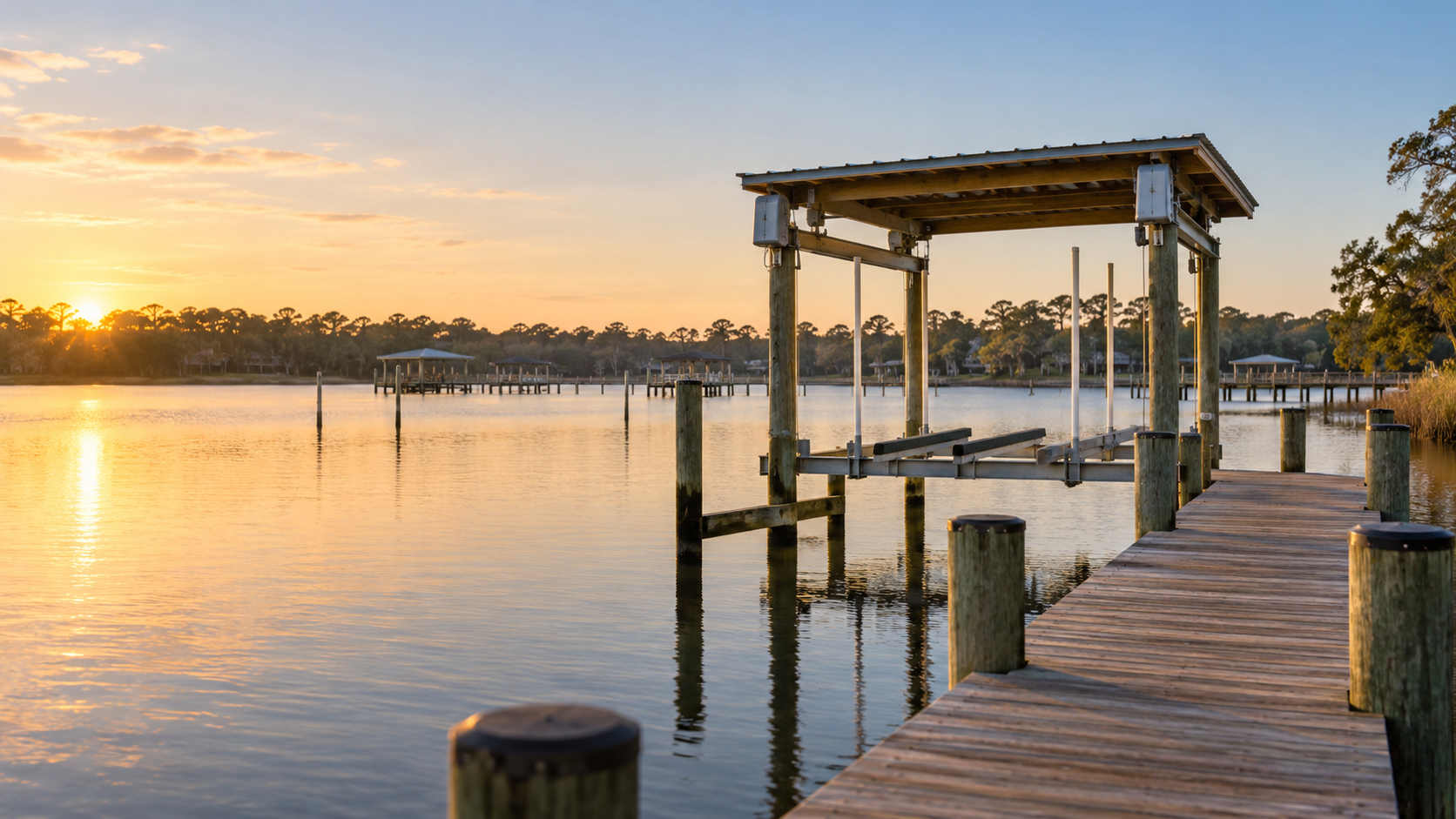
10 Questions to Ask Before Buying a Home With a Boat Slip in Orange Beach
Buying a home with a boat slip in Orange Beach is two purchases in one.
The house follows the usual rules. The dock answers to the city, the US Army Corps of Engineers and the state, and the slip itself may or may not be yours.
These are the ten questions to ask before the inspection period ends.
The ten questions, in short:
- Whether the slip conveys with the home
- Whether the pier was properly permitted
- Legal limits on dock length and spacing
- Water depth at the slip at low tide
- Rights to rebuild or add a boathouse
- Spacing from neighboring docks and boats
- Whether a state riparian easement applies
- Rules on renting or sharing the slip
- Who maintains the dock and pays for it
- Whether insurance covers the dock itself
1. Is the boat slip actually included in the sale, or just the right to use one?
A boat slip can be three different things. It can be deeded property that transfers with the unit, a limited common element assigned to one unit, or a use privilege the association hands out and can take back. Ala. Code 35-8A-208(a) requires the declaration to specify which unit each limited common element is allocated to, so the recorded paperwork answers this.
A strong answer points to the recorded declaration or the deed, names the slip by number, and shows where it is written. In Orange Beach, where Heather Loper & Associates works, that language sits in the condominium declaration on file with the association. Ask for the page, not a summary.
Hearing that the slip goes with the place, with nothing on paper, is the answer to worry about. An assigned slip can be reallocated by an amendment executed by the owners involved. Not automatically a dealbreaker, but it changes what the home is worth.
2. Has the pier been permitted, and by which agencies?
A private pier in Orange Beach needs more than a contractor. Article 5.19 of the city zoning ordinance, which covers piers, decks and pier or boat houses, requires a building permit from the Department of Community Development. The same section requires the construction to be approved by the US Army Corps of Engineers and all other applicable local, state and federal agencies.
A strong answer comes with the permit file: the city building permit, the Corps authorization, and the date each was issued. Sellers who built the dock themselves usually remember the year. Ask the city to confirm the address has a closed permit rather than an open one.
An answer that the dock was already here when the seller bought is not an answer. It is also common, and often fine. The risk is that a dock built without approval cannot always be rebuilt the same way.
3. How far out into the water is the dock allowed to go?
Dock size is capped by the waterway, not by the lot. The Corps Mobile District authorizes most private piers in coastal Alabama under a general permit for piers and pile-supported structures. Under the version effective October 2021 through October 2026, a structure extending more than 25 percent of the overall width of the waterway fell outside that permit, and none could be built within 100 feet of a federally maintained navigation channel. Ask the Corps which permit is current.
A strong answer gives the dock's length and the width of the canal in front of it. On a narrow Orange Beach canal, 25 percent of the water goes quickly. The general permit is reissued every five years.
A seller who promises the dock can be extended later has promised something three agencies control. An extension past the general permit thresholds may still be possible, through an individual Corps permit.
4. Is the water deep enough at low tide for the boat I own?
Depth at the dock decides which boat fits, and depth changes with the tide and with the last storm. Corps permit conditions expect a pier to be long enough to reach water deep enough for the use proposed, which means this dock was sized for somebody else's boat. Back bays around Orange Beach silt in over time.
A strong answer is a number taken at low tide with a pole or a depth finder, at the end of the slip rather than at the bulkhead. Go back at low water and check it. Ask neighbors what they run and whether anyone has dredged recently.
Plenty of water is not a measurement. Neither is a photo of a boat at the dock at high tide. A slip that is short by a foot at low water turns into a tide schedule, and dredging needs its own approvals.
5. Can I rebuild or add a boathouse over the slip?
Boathouses in Orange Beach are governed by Article 5.19 of the zoning ordinance, which covers piers, decks and pier or boat houses. A building permit is required, and so is approval from the Corps and other applicable agencies. Setbacks for a waterfront accessory structure are set in that section, so read it against a current survey rather than assuming the rear line behaves the way it does on an inland lot.
A strong answer shows the side lot lines on a survey and where the existing structure sits against them. Ask the city's Community Development staff what a replacement at that footprint would need. A current survey costs far less than a denied permit.
An answer that the neighbors all did it is not a zoning opinion. Older docks often sit under rules a rebuild would not get. The cost shows up when a storm damages the structure.
6. What stops the neighbor's dock or boat from crowding mine?
Spacing is set by riparian lines, which rarely match the lot lines on land. The Alabama Department of Conservation and Natural Resources, State Lands Division, imposes a 10 foot minimum between an authorized structure and the adjacent upland property lines and riparian lines, as a condition of the general permits for excavated boat slips and maintenance dredging. Whether it reaches a given pier depends on which permit the work is done under.
A strong answer is a survey that shows the riparian lines, not only the uplands. In Orange Beach back bays, where lots fan out around a bend, the water boundary can sit well off the fence line.
Everybody gets along here is a fine answer today and worth nothing at closing. Most dock neighbors never argue. The ones who do argue about the riparian line, and a buyer with no survey has nothing to argue from.
7. Does the dock need an easement from the state?
Docks sit over state water bottoms, so the state has a say. The Alabama Department of Conservation and Natural Resources, State Lands Division, may require a riparian easement for a structure over state owned bottoms. The larger the structure, and the further it gets from a single household's own use, the more likely that question becomes.
A strong answer says whether an easement exists and produces it. Shared docks, multi slip piers and anything serving more than one household are the structures that draw the question. Call the State Lands Division with the deck dimensions and the shoreline frontage and ask them, rather than working from a rule of thumb.
An answer that nobody around here has one may be accurate and still leaves the buyer exposed. The real question is whether this structure, at this size, for this use, needed one.
8. Am I allowed to rent the slip out or let friends keep a boat there?
Renting a slip turns a private dock into something closer to a commercial use, and two sets of rules notice. Association documents usually control who may tie up at a limited common element slip. A dock used by more than a single household can also raise the State Lands riparian easement question. Slip income is rarely as simple as it looks.
A strong answer quotes the association rule on guests, leases and boats belonging to non owners, and says whether the city treats the activity as a business. Written rules beat a neighbor's habit.
People do it all the time is the answer that costs money later. Some buildings allow slip leases between owners only. Not every rule is enforced, which is exactly why a buyer who paid for rental income needs that rule in writing before closing.
9. Who maintains the dock, and what does that cost each year?
Maintenance follows ownership. A deeded slip is usually the owner's to maintain. A limited common element slip is often maintained by the association and billed back to the owners who use it. Pilings, decking, wiring and lifts all have a service life in salt water, and the bill arrives as dues, a slip fee, or a special assessment.
A strong answer separates three buckets: regular dues, any slip specific fee, and the reserve set aside for the dock. Ask for three years of association financials and look for dock line items. Ask when the pilings were last replaced.
A dock with no reserve behind it is a special assessment waiting for a hurricane. Watch for an association that has never funded dock reserves and has never had to. That is luck rather than planning, and buyers inherit the bill either way.
10. Will insurance cover the dock if a storm destroys it?
Flood insurance does not cover docks. The standard flood insurance policy lists wharves, piers, bridges and docks among the property it does not cover, alongside fences, seawalls and bulkheads. Wind coverage for a dock depends on the policy and is often limited or excluded. On the Alabama coast that gap is the most expensive surprise a waterfront buyer can hit.
A strong answer is a written quote that states, in policy language, whether the dock and the lift are covered and for how much. Ask a coastal Alabama agent before the inspection period ends.
It is all covered, with no policy pages behind it, is the answer to push on. Many owners carry the dock as a known risk and plan to rebuild out of pocket. That is a reasonable choice, and a very different budget from the one most buyers assume.
Four separate approvals, and a dock usually needs more than one.
| Approval | Who issues it | What it controls |
|---|---|---|
| Building permit | Orange Beach Community Development | Pier, deck and boathouse construction |
| Corps authorization | US Army Corps of Engineers | Work in the water and navigation |
| Riparian easement | Alabama State Lands Division | Large or non residential structures |
| Association consent | Condominium or homeowner board | Slip assignment, guests and leases |
Frequently Asked Questions
Is a boat slip in Alabama considered real property?
It depends how the slip was created. A slip that was separately deeded, or recorded as a limited common element allocated to a specific unit, is an interest in real property. A slip the association simply assigns is a use right. The recorded documents settle it, so a title search answers the question.
How much does a boat slip add to the value of a home?
Enough that it should be appraised rather than guessed. An appraiser treats a deeded slip as part of the property and looks for comparable sales that included one. Value swings with water depth, bridge clearance and the run out to open water. Ask for comparable sales that had slips.
Do I need a permit to add a boat lift in Orange Beach?
Plan on it. Orange Beach requires a building permit from the Department of Community Development before piers, decks and boathouses are built, and also requires approval from the US Army Corps of Engineers and other applicable agencies. Call Community Development with the address first.
What is the difference between a canal lot and a bay front lot for boating?
Access and exposure trade against each other. A canal lot is calmer and usually less expensive, with a longer run out to open water. A bay front lot gets there faster and takes more weather at the dock. Buyers comparing the best real estate agents in Orange Beach should ask to walk both.
What should I check about bridge clearance before buying a slip?
Air draft, and it is easy to miss. Some Orange Beach canals sit behind fixed bridges, and the clearance decides whether a boat with a tower or a mast can get out. Measure the boat's height above the water, then ask a local captain about clearance at high tide.
Talk to Heather Loper & Associates before the inspection period ends
Heather Loper & Associates is a real estate team working in Orange Beach and Gulf Shores. Waterfront buyers who want the slip paperwork, the permit file and the dock insurance question handled before the inspection period closes, and buyers comparing Orange Beach realtors, can start at heatherloper.com or call (251) 504-1171.
This article is general information about buying waterfront property in Alabama. It is not legal, tax or insurance advice. Permit rules and policy terms change, so confirm your own situation with the City of Orange Beach and a licensed Alabama professional.
or another way